Top 5 Overlooked Factors in Choosing a Precision Gear Partner for Supply Chain Reliability

Introduction
Making a decision to pick a precision gear supplier for the creation of innovative medical devices, robotics, or highly sophisticated industrial machinery by only factors like cost, delivery time, or equipment lists can hellish. Variations in product quality halt production completely, while lack of sufficient supply chain resilience hinders the capability to meet increased demand and also risks to the projects.
Why does that happen? The explanation lies in the traditional approach to assessing suppliers, which is static and narrowly focused. Instead of focusing on the dynamics of supply chains and depth of collaboration required to ensure supply chain resilience, such models pay excessive attention to the “sticker price” and “capacity of vendors.” Real risks lurk in the vibrancy of the quality culture, proactive risk management, scalability from prototypes to manufacturing, and ability to evolve from transactional interaction into value co-creation. This paper identifies five essential but often neglected aspects of supply chain resilience.
Why Is an ISO 9001 Certificate Not a Warranty for Batch Consistency in Large Volume Production?
The ISO 9001 certificate is only the beginning and not the warranty. Real QA in the large volume production lies in the active culture of preventive process control, not in the reactive inspection system. The certificate proves the existence of the system, while the SPC and Cpk charts show its efficiency. To evaluate your partner, you need to analyze the system of operational processes used by your business partner, and this is the best quality management tool possible. Standards such as IATF 16949 in reliability-driven industries are all about preventive control based on statistics. Evaluation of your partner’s ability to fulfill standards requires analyzing the implementation of such requirements as monitoring of special characteristics. This insight on building an efficient quality system needs proper systematic knowledge. There is an excellent resource on the construction of such a system in one of the top precision gear manufacturing companies.
1. From Framed Certificate to Control Chart: Evidence of Process Stability Required
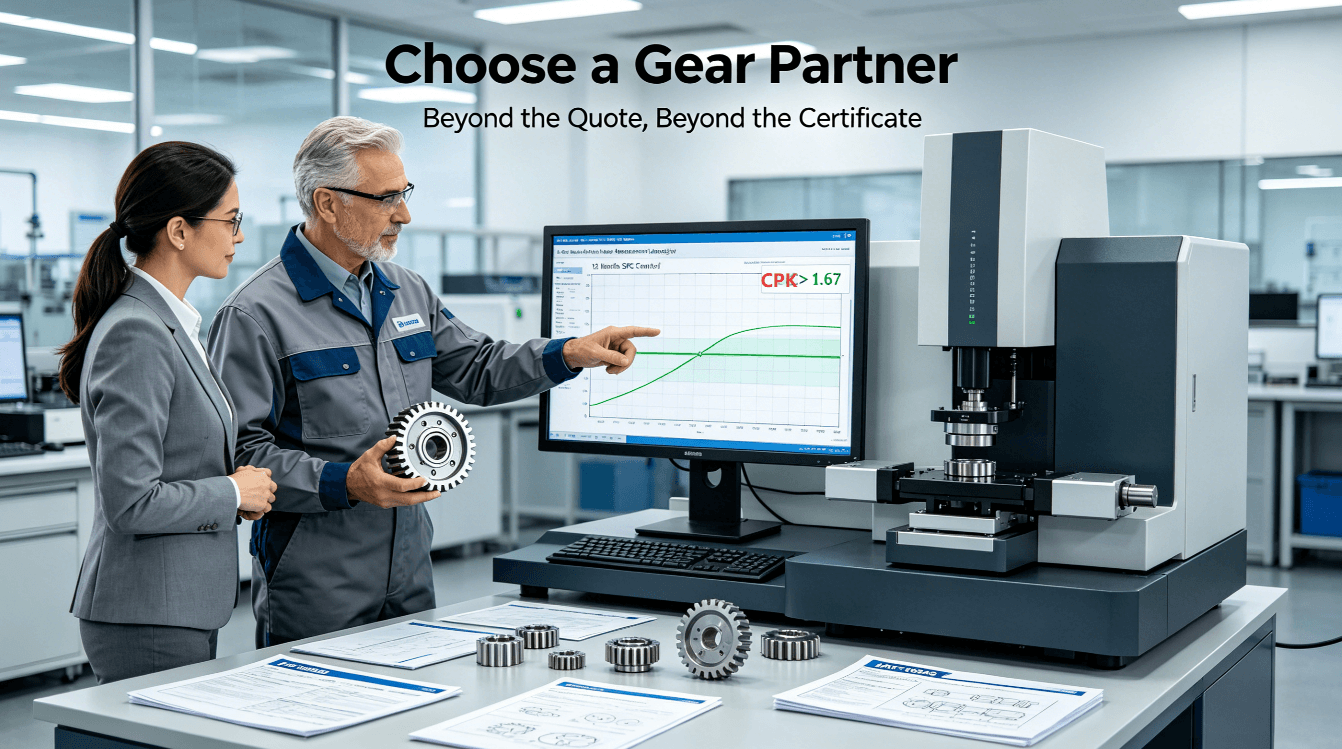
Go beyond the framed certificate. When evaluating a potential partner, insist on seeing a minimum of 12 months’ worth of SPC chart data for critical attributes such as tooth profile error and gear runout. Expect to see an ongoing X-bar and R chart demonstrating that the process remains under statistical control. You have evidence-based proof that your prospective partner has the manufacturing capabilities to produce quality parts; that’s something a simple certificate will not provide you.
2. Understanding Cpk: The Statistical Tool for Guaranteeing Reliability
Process Capability Index (Cpk) is a great tool. If the Cpk is equal to 1.33, then it shows that the process is reliable. But when you see the index higher than 1.67 consistently, it proves the superiority of your business. You should find out the Cpk of your partner for certain critical characteristics. A company that manages to achieve a Cpk of 2.0 for gear runout among thousands of parts can be considered truly reliable.
3. Responding to Signals: The Prevention Culture
The hallmark of a developed quality management system is its response to signals, not merely detection of breakdowns. Question how your supplier manages “out-of-trend” signals on an SPC chart before any parts become defective. Do they have a formalized procedure for escalating and investigating such warnings? A supplier who addresses leading signs of deviation demonstrates their commitment to prevention culture. This forward-thinking approach is essential for safeguarding your assembly line from disruptions due to batch defects and ensuring the continuous flow of precisely machined gear components.
How Is Your Potential Supplier Managing Risk Proactively in the Supply Chain?
The new perfection in the supply chain is geared resilience as opposed to the managing of fires. A good provider sees risks coming and responds in ways that prevent them. Staying a step ahead is not just about buffer stock; it means coming up with a plan such as sourcing materials from two different suppliers and capacity reservation mechanisms. You need to look at your partner’s supply chain and business continuity planning deeply to gauge their resilience capacity.
1. Beyond One Source: Securing Multi-Level Supply Chain
Reactive partners rely on a single supplier. Proactive partners design supply chains for resilience. Ask whether they have contingency plans for crucial raw material sources such as specialty alloy steels. Are there multiple approved suppliers? How do they manage their supplier relationships and performance? The multi-level security will guarantee that a potential problem at one plant will not be catastrophic for your operations, ensuring continued access to precision gear components.
2. Capacity Reserves and Forecast Integration
Collaboration means mutual transparency and planning. Have they got a mechanism for allocating their production capacity or dedicated cells for strategic clients? Would they reveal their plans for capacity expansion? In addition, examine their agility: do they possess “mixed flow production” capability for niche requirements? Partners who incorporate your forecasting into theirs and build flexibility into their capacity reserves will offer you an adaptive and dependable supply chain.
3. A Validated Business Continuity Strategy
Any company can probably keep a plan in a folder, but only the resilient one will show their business continuity plan by conducting tests or audits. When you ask them, their Business Continuity Plan (BCP) may have been approved or reviewed not long ago. What is their allowable downtime after disruption for critical processes? In the same way, what is their logistics risk management approach to alternative routes and alternative inventory programs such as Vendor Managed Inventory (VMI)? All these interactions will reveal a company that keeps its commitments, thus being your reliable supplier of gears.
Do They Have a Methodology for Efficient Scaling from a Prototype to Volume Production?
It is a widely-known problem for manufacturers that the transition from the perfectly designed prototype to mass production is often filled with errors leading to losses and missed deadlines. To achieve seamless scaling, you need an appropriate methodology, not a shot in the dark. Your manufacturing partner should have a way to transition proven parameters of a prototype into a scalable control plan.
- Prototyping with Production Intent: Creation of the “Data Twin”: Instead of a stand-alone effort, prototyping needs to mimic actual production practices as much as possible. Consider whether the manufacturer utilizes production grade materials and processes in even prototyping quantities. Do they apply the same heat-treating process cycle they would for volume production? This creates a “digital twin” of the manufacturing process, right out of the gate. The data gathered – feeds and speeds, inspections – serves as the initial dataset for production, making it unnecessary to make any guesses about how things might scale up.
- Process Validation and Pilot Lines: As the saying goes, it is important to walk before you can run. A competent partner has a production part approval process in place. It entails conducting capability studies on a pilot line, which is essentially a reduced version of the complete production line. In such a way, the process variation is determined and eliminated. Such an approach enables a methodical and gated transition, ensuring that the process is characterized and capable prior to ramping up to full-scale production.
- Knowledge Continuity and Cross-Functional Transition: Tacit knowledge is usually the most important thing about scaling. Make sure that the engineering team behind the prototype is integral to the manufacturing launch process. The understanding of the “whys” behind each machining step and each fixture setup is crucial here. In addition, there must be a well-defined hand-off process where the partner transfers the qualified manufacturing process from development/NPI to the production function, providing detailed instructions and training on the same.
Does the Partnership Focus on Minimizing Total Cost of Ownership and not Unit Price?
Partnerships are built to maximize their benefits and minimize the Total Cost of Ownership and not the price per unit alone. TCO consists of acquisition costs, cost of quality issues, cost of risk management, and the benefits of efficient operation. The partner who focuses on total cost will help achieve better designs through co-development; eliminate waste through statistical controls; and increase value through lifetime product support.
- Co-Development and Design for Excellence: The most leverage one gets in managing TCO happens during the design phase. An effective partnership involves co-design, where changes can be made to gear geometry for optimization. These improvements may make a design less complicated to manufacture, increase its efficiency, and reduce its cost. Such a saving is built into the product even before any metal work is done, ensuring a better value from the product. This is an example of co-engineering, which should happen between partners, but not vendors.
- The Cost of Quality and Risk Management: It is no good having a cheap unit price only to incur huge hidden costs. Calculate what the cost of non-conformance would be; consider internal sorting costs, downtime losses due to defects, warranty claims, and costs incurred in urgent shipments. With near-zero defect rates due to their use of SPC and 100 percent automatic inspection on key characteristics, a partner eliminates such costs almost entirely. So does their strong SCM process make the cost of any unforeseen downtime virtually zero. Discuss your reliability goals and develop this TCO model.
- Lifecycle Support and Sustainable Value Creation: It’s not just about the order at hand – there’s more to be had from a good business relationship. Learn whether your potential partner provides predictive maintenance, remanufacturing, or technology refreshes. If your partner is providing you ways to stretch the service life of your drives or plan for eventual upgrades, then he/she is effectively helping you save costs on capital and operations. The business relationship is evolving from transactional to strategic, maximizing lifecycle efficiency, which will help keep your TCOs down throughout your assets’ lives.
Securing Ten Years of Supply for a Surgical Robotics Platform Through a Deeper Partnership
One such example that demonstrates the value of the framework is as follows: A global medical device manufacturer had unacceptable noise variation (failure rate of 15%) and supply concerns with a crucial component for its surgical robot. The current vendor was unable to help them overcome these challenges. Their solution was not a new vendor but a deeper partnership. This partner embarked on an extensive joint manufacturing study of 60 days to optimize the process of micro grinding. This resulted in an innovative 10-year strategic partnership that involved investments in an exclusive gear line with pre-committed capacities and agreed costs, along with shared improvement goals. As a result, the project produced an impressive first-pass yield of 99.95%, along with noise level three dB lower than specifications.
1. The Problem: From a Technical Issue to a Strategic Platform Risk
It was not just about addressing the noise problem; it was a matter of platform risk. Inconsistency could affect the clinical efficacy of the device and the development time frame. Supply risks would impact the worldwide introduction of a flagship product. It was not a matter of sourcing parts anymore; it was a strategic need for a partner who would tackle the micro-geometry challenge and ensure a reliable supply for the life cycle of the product.
2. The Partnership Approach: Combining Technical & Commercial Innovations
The partner delivered on both fronts. On the technical side, they used root cause analysis and process innovation to develop the precision micro-grinding of the gear. On the commercial side, they offered a new type of partnership approach: a long-term relationship whereby the company would invest in dedicated infrastructure to produce the component for life cycle. The incentive for continuous process improvement was aligned for both parties.
3. The Result: Converted Risk Into Competitive Advantage
Not only did this collaboration provide a functional gear, but it also gave an assurance of future logistics, consistent costs, and a joint innovation system. The customer received a guaranteed ten years of risk-reduced supply, while the partner benefited from a strategically sound alliance for the future. This case demonstrates that the most profound supplier risk management strategy entails ceasing the management of the vendor and starting to create the partner, thereby converting a potential weakness into a competitive strength.
Your Strategic Partnership Evaluation Checklist: Transitioning From the RFQ.
To change from using the RFQ approach to the assessment of a strategic partner, you have to start a different dialogue. Here is a list that can help you discover what you really want to know about your future business partner. For maximum certainty in building a partnership, it is crucial to identify a company that could naturally extend your engineering and operational capabilities. Therefore, to create a manufacturing alliance of the future, you have to find a partner with similar values and capabilities. As a strategic partner with certification according to IATF 16949 and AS9100D, their advantage is the ability to provide integrated engineering, clear collaboration, and intelligent supply chain management. If you need all these services in one package, it is advisable to start looking for partners among CNC machining gears manufacturers.
1. Quality & Process Depth: Questions for the Quality Director
The evaluation of the quality philosophy of an organization requires that the focus be changed from merely compliance-oriented audits to more robust process control approaches. Ask to see real-time SPC charts on the attribute of the gear that matters the most in terms of its application. In addition, delve into how the organization deals with any significant deviation from standard practices by asking them what was included in the 8D report, and what kind of permanent corrective action was taken. Finally, determine whether their quality management system is integrated with raw material suppliers and processes after processing, like heat treatment.
2. Resilience and Commercial Synergy: Questions for the Director of Operations/Commercial
Evaluate the resilience and sustainability aspect of the supply chain by highlighting risk management tools that are not simply reactive, but also proactive, and a well-balanced commercial partnership plan. Inquire about their dual sourcing policy of the critical component in question and verify that they are certified for both sources when assessing redundancy. Describe the possible approaches to contract signing with the partner with a long-term perspective on the relationship such as index pricing formulas, reserve capacity pools, and joint capacity development strategies. At the end, request their Business Continuity Plan demonstrate their capacity to survive if they were without their main facility for two weeks.
3. Innovation & Strategic Vision: Questions for the Engineering/Business Development Director
To get at the partners’ innovativeness and overall strategic orientation, one should look beyond their capability to help you solve your current problems and also consider their openness to co-creation. Request your partner to share a case study that vividly describes a scenario when collaborative innovation led a customer to significantly enhance the performance or reduce the cost of the product. Understand the workings of IP sharing in joint development by laying out a sample agreement of background/foreground IP. Further, get their take on which technological innovation in gear production will play the biggest role in the next five years.
Conclusion
When dealing with precision gears in top-end manufacturing, it is important not to consider this process as procurement, but as a strategic investment. Using a five-point evaluation criteria that includes analyzing the dynamism of quality systems, engineering for resilient supply chains, strategies for smooth scaling up, architectures for cost minimization, and approaches for collaborative engagement will enable companies to transform their vendor relationships into strategic manufacturing partners. This allows firms to shift their focus from being transactional to being value-added and risk-sharing partners, creating the strongest possible manufacturing platform for innovation.
FAQs
Q: What is the difference between a “vendor” and a “strategic manufacturing partner”?
A: The distinction lies in the fact that in vendor relationships, the concern is about per unit cost and delivery only. On the other hand, when working with strategic manufacturing partners, the relationship goes beyond simple transactional activities and includes long-term objectives, design/process optimization cooperation, joint investments, cost transparency, and risk management.
Q: How do you ensure that a prospective gear producer possesses a genuine “quality culture?”
A: Don’t be satisfied with certificate checks. Have them show you their SPC charts from the ongoing production process. Have them walk you through a past non-conformity and how they solved it. Observe the factory floor for discipline and visual management. If they are willing to share this information, then you are likely looking at a quality culture that is alive and well.
Q: What key elements must a long-term contract have between yourself and your chosen manufacturer partner?
A: Your contract should have all of these elements: a commitment to capacity, formula-based price changes in relation to commodity indices, co-development provisions, improvement goals, and contingency plans.
Q: Is it realistic for a sole partner to take care of both our prototype gears with complicated design and lower volume as well as future volume gears?
A: Yes, it is possible if the partner has established processes specific for each phase of work – agile cells for prototypes vs. dedicated volume lines. It is important to have a transition methodology – using production-specific materials/production processes for prototypes and scale-up methodology. Ask about their documented scale-up methodology during the assessment phase and provide examples.
Q: What are the steps to calculate Total Cost of Ownership (TCO) for gear manufacturing partners?
A: First, list down all the segments of your TCO like: Acquisition Costs (component and tooling cost), Cost of Quality (failure, inspection costs), Cost of Risk (downtime, expediting costs), and Cost of Operation (ease of assembly, maintenance costs). Usually, partners with a higher unit price but better quality/reliability/design support have significantly lower TCO.